
A Practical Guide to Ecommerce Product Catalog Management
Clura Team
Ecommerce product catalog management is the process that turns a chaotic mess of supplier data into a clean, trustworthy foundation powering your entire customer experience. Without it, you're not running an online store — you're managing a very messy digital stockroom.
Great catalog management directly impacts sales, SEO, and return rates. This guide walks through the core concepts, a proven four-step workflow, and the AI-powered tools that let you automate the most tedious parts — including pulling competitor pricing and enriching listings from manufacturer pages.
Automate Your Product Catalog Workflows
Clura can pull product specs, pricing, and images from any supplier or competitor website automatically. No dev work required.
Add to Chrome — Free →Why Is Product Catalog Management So Important?
Product catalog management is the strategic system that organises every piece of product data — from SKUs to marketing copy — ensuring customers can find and trust what they see across every sales channel.
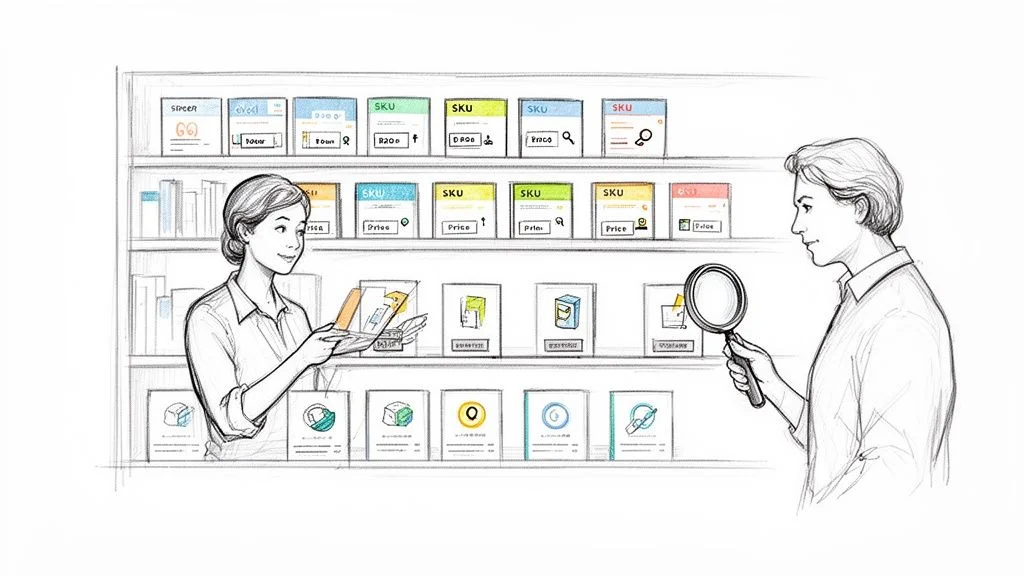
When your product information is accurate, consistent, and rich with detail, you create a shopping journey that just works. The impact is immediate and measurable.
- Boosted sales and conversions: clear titles, accurate specs, and helpful filters remove friction from the purchase path.
- Improved SEO performance: structured, high-quality data helps product pages climb search rankings organically.
- Reduced returns: detailed, accurate descriptions ensure customers know exactly what they're buying.
- Enhanced customer trust: a professional, error-free catalog signals brand credibility.
Your product catalog is your digital storefront. Every piece of data — from the SKU to the marketing copy — is an opportunity to either win or lose a customer.
The global Catalog Management System Market is projected to reach USD 3.73 billion by 2031, driven by the need for unified data to power personalisation and omnichannel selling.
Building Your Catalog With Strong Data and Taxonomy
A data model defines every possible attribute for a product (SKU, colour, dimensions), while taxonomy is the hierarchical category structure that lets customers browse intuitively — together they are the foundation of any well-managed catalog.
The Blueprint: Your Data Model
Your data model is a complete checklist of every attribute that could describe a product. For a t-shirt this includes core identifiers (SKU, title, brand), descriptive attributes (colour, size, material), media assets, pricing, and logistics data. Defining this blueprint upfront prevents data chaos as you scale.
The Aisle Signs: Your Taxonomy
A great taxonomy doesn't just organise products — it mirrors how your customers think and shop. It anticipates their journey and leads them directly to the perfect item.
A well-designed taxonomy guides shoppers from broad to specific: Men's → Shoes → Athletic Shoes → Running Shoes. Studies have found that 12% of top ecommerce sites still have major issues with their category navigation — get this right from the start by following proven category management best practices.
The 4 Pillars of a Winning Catalog Workflow
Every great catalog operation follows four stages: Ingestion (gather raw data), Normalization (standardise it), Enrichment (add compelling content), and Publishing (push to all sales channels).
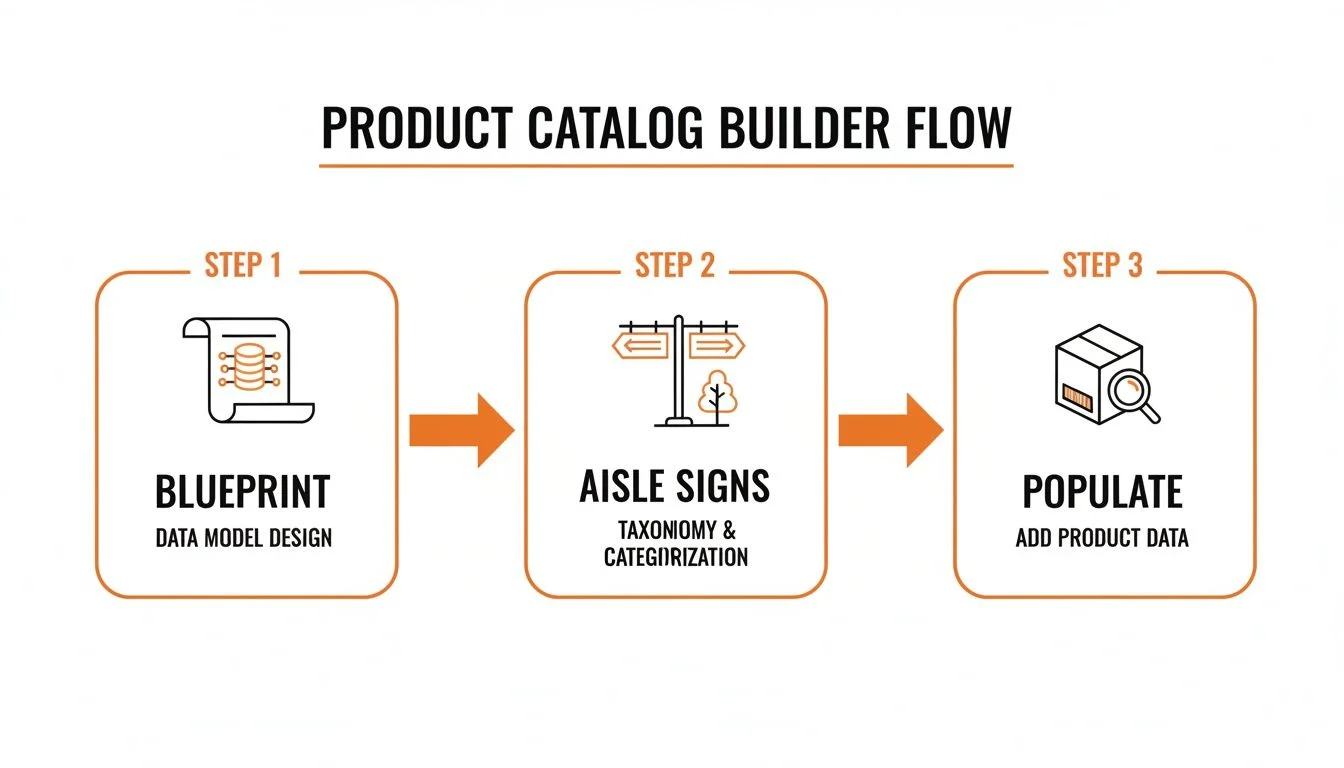
1. Ingestion
Gather all product data in one place — supplier CSVs, legacy ERP exports, manual entry, and web scraping to fill in missing specs from manufacturer pages. At this stage, the goal is quantity, not quality.
2. Normalization
Normalization is the unsung hero of catalog management. It turns 'BLK', 'Blk', and 'Black' into one standard value — making your site's filters and search actually work.
3. Enrichment
Write SEO-friendly product descriptions, upload high-resolution images, add customer reviews, and pull in competitor pricing data to sharpen your strategy. See our guide on how to automate online price tracking for the competitive intelligence piece.
4. Publishing
Push polished data to your main ecommerce site, Amazon, eBay, social commerce channels, and your mobile app — ensuring every customer sees the same high-quality information no matter where they find you.
Automating Your Catalog With AI-Powered Tools
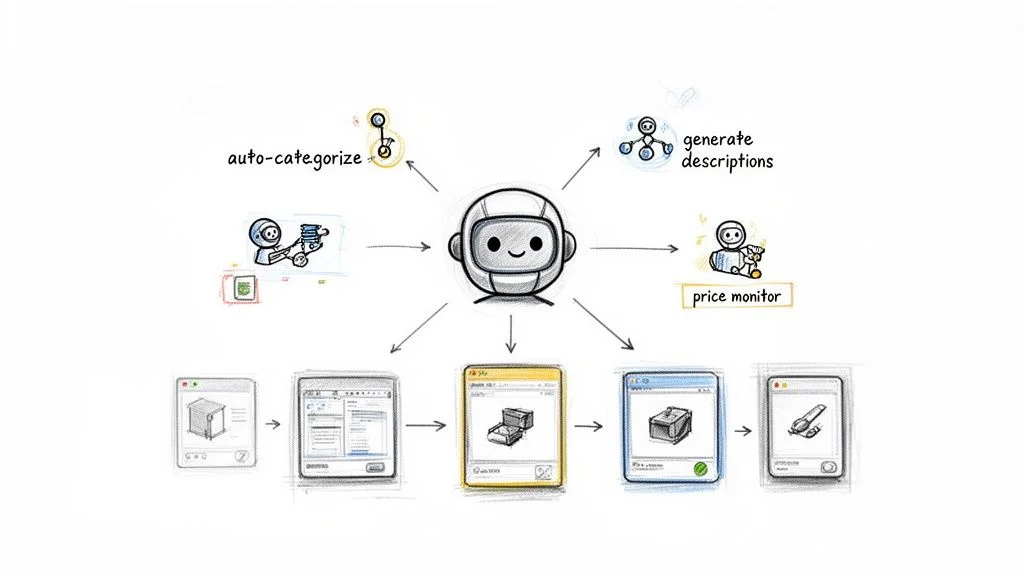
AI catalog automation handles repetitive tasks — auto-categorisation, description generation, competitor price monitoring, and supplier data extraction — in seconds rather than hours.
| Task | Manual Method | Automated Method |
|---|---|---|
| Adding new products | Copy-pasting specs from supplier PDFs one SKU at a time | AI agent extracts all data from supplier sources and populates product fields in seconds |
| Writing descriptions | Hours rewriting supplier copy for hundreds of products | AI generates unique, SEO-optimised marketing copy for the entire catalog in minutes |
| Tracking competitors | Employee visits 10+ sites daily, logs prices in a spreadsheet | Browser agent scrapes all competitor prices hourly and alerts you to changes automatically |
| Categorising items | Manager manually reviews each new product and guesses the category | AI model analyses product attributes and assigns the correct category instantly |
Pull Missing Product Specs Automatically
Clura can visit manufacturer or competitor pages and extract specs, images, and pricing into a clean CSV — ready to upload to your PIM or store.
Add to Chrome — Free →If you sell on Shopify, get started immediately with our prebuilt Shopify product catalogs scraper template.
Get Your Catalog Ready for the Future of Commerce
By 2026, AI shopping agents will discover and recommend products based purely on structured catalog data — making data quality the single biggest factor separating ecommerce winners from losers.
The future is Agentic Commerce: a customer's personal AI assistant searches for 'a waterproof black GORE-TEX hiking boot under $200 with great reviews for wide feet' — and it reads nothing but raw, structured product data to decide what to recommend. If your catalog can't clearly communicate those attributes, your product simply won't exist to that agent or the customer.
Industry leaders predict that by 2026, catalog readiness for AI-driven retail will be the single biggest factor separating winners from losers. You can read more about upcoming 2026 ecommerce trends to see how large this shift will be.
Frequently Asked Questions
How much does a PIM system cost?
Entry-level SaaS PIM options for small businesses start at a few hundred dollars a month. Enterprise-grade platforms can run into thousands, especially with custom implementation. Focus on a solution that fits your current catalog size — avoid over-buying early on.
Can I manage a product catalog without a PIM?
Yes — most businesses start with a well-organised spreadsheet. The challenge comes once you're juggling thousands of SKUs, multiple sales channels, and data from many suppliers. That's when mistakes start costing money and a dedicated tool becomes essential.
What is the difference between a PIM and a DAM?
A PIM (Product Information Management) system is your command centre for text-based data: SKUs, titles, descriptions, specs, and pricing. A DAM (Digital Asset Management) system is a specialised library for creative files: photos, lifestyle images, videos, and PDFs. Modern PIMs often include some DAM features, but they serve fundamentally different purposes.
How does web scraping help with catalog management?
Web scraping automates the most tedious catalog tasks: pulling missing specs from manufacturer pages, monitoring competitor prices in real time, and enriching listings with up-to-date images. Tools like Clura let non-technical teams set up these workflows in minutes.
Conclusion
Ecommerce product catalog management is no longer a back-office chore — it's a strategic competitive weapon. Clean, structured, attribute-rich data powers better search rankings, higher conversions, fewer returns, and visibility in the AI shopping channels that are reshaping retail.
Start by defining your data model and taxonomy, build a four-stage workflow, and then layer in automation to handle the repetitive parts. The teams that get this right now will be the ones AI agents recommend tomorrow.
Explore related guides:
- Amazon Product Listing Optimization — turn your catalog data into high-converting Amazon listings
- Automate Online Price Tracking — monitor competitor prices across every channel automatically
- Retail Price Monitoring Guide — practical strategies for turning price data into margin improvements
Ditch Manual Data Entry and Automate Your Catalog
Clura is an AI-powered browser agent that pulls product data from any website automatically. Gather competitor pricing, enrich listings, and sync supplier info without lifting a finger.
Add to Chrome — Free →About the Author